PROGRAMME

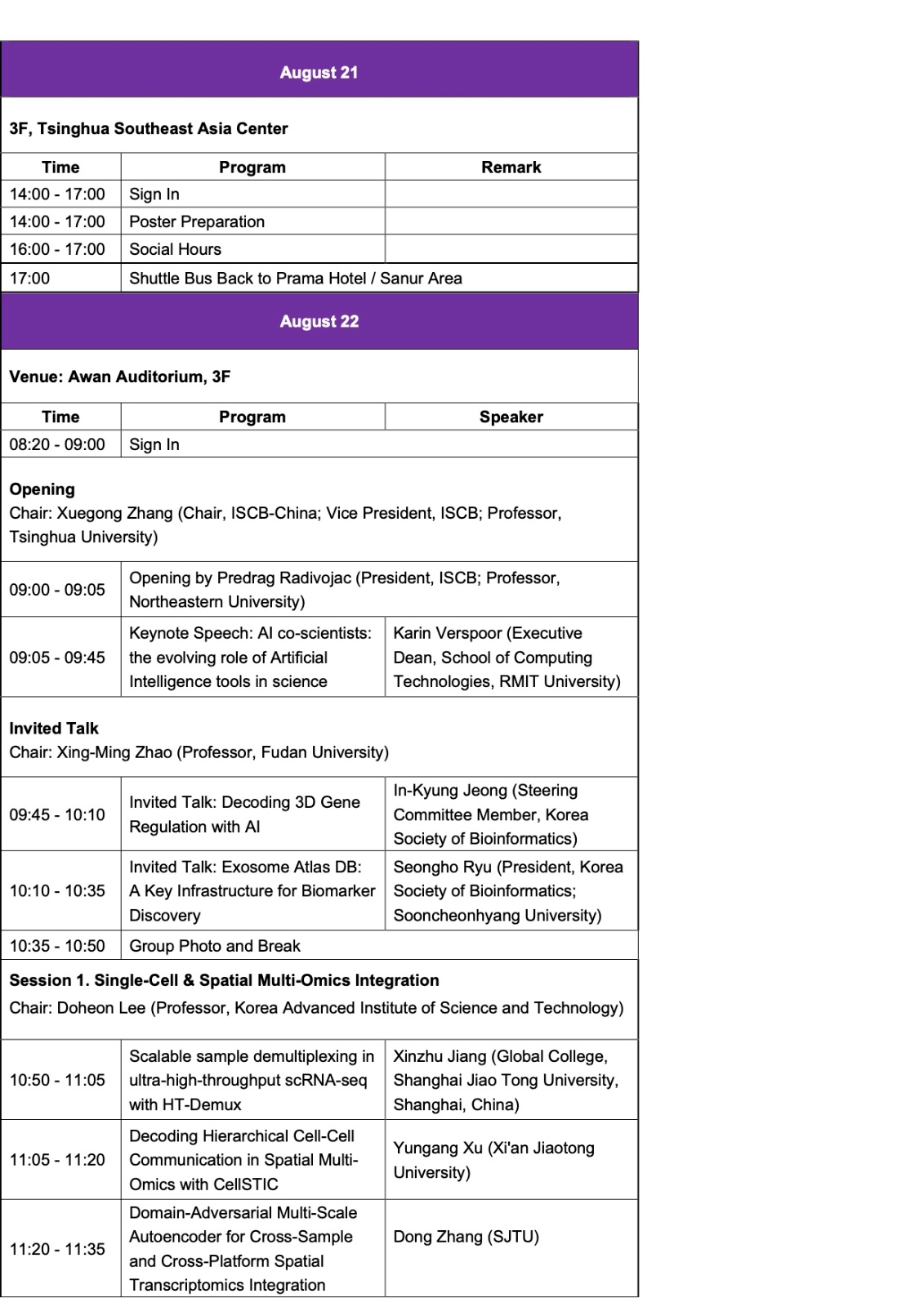
August 21

3F, Tsinghua Southeast Asia Center

Time

Arrangement

Remark

14:00 - 17:00

Sign In


14:00 - 17:00

Poster Preparation


16:00 - 17:00

Social Hours


17:00

Shuttle Bus Back to Prama Hotel / Sanur Area

August 22

Venue: Awan Auditorium, 3F

Time

Arrangement

Speaker

08:20 - 09:00

Sign In


09:00 - 09:05

Opening


09:05 - 09:45

Keynote Speech: AI co-scientists: the evolving role of Artificial Intelligence tools in science

Karin Verspoor(Executive Dean, School of Computing TechnologiesRMIT University)

09:45 - 10:10

Invited Talk:  Decoding 3D Gene Regulation with AI


In-Kyung Jeong (Steering Committee Member, Korea Society of Bioinformatics)

10:10 - 10:35

Invited Talk: Exosome Atlas DB: A Key Infrastructure for Biomarker Discovery

Sungho Ryu (President, Korea Society of Bioinformatics; Sooncheonhyang University)

10:35 - 10:50

Group Photo and Break

Session 1. Single‑Cell & Spatial Multi‑Omics Integration

10:50 - 11:05

Scalable sample demultiplexing in ultra-high-throughput scRNA-seq with HT-Demux

Xinzhu Jiang (Global College, Shanghai Jiao Tong University, Shanghai, China)

11:05 - 11:20

Decoding Hierarchical Cell-Cell Communication in Spatial Multi-Omics with CellSTIC

Yungang Xu (Xi'an Jiaotong University)

11:20 - 11:35

Grounded integration of single-cell multi-omics data with CITE-pool

Xinzhu Jiang (Global College, Shanghai Jiao Tong University, Shanghai, China)

11:35 - 11:50

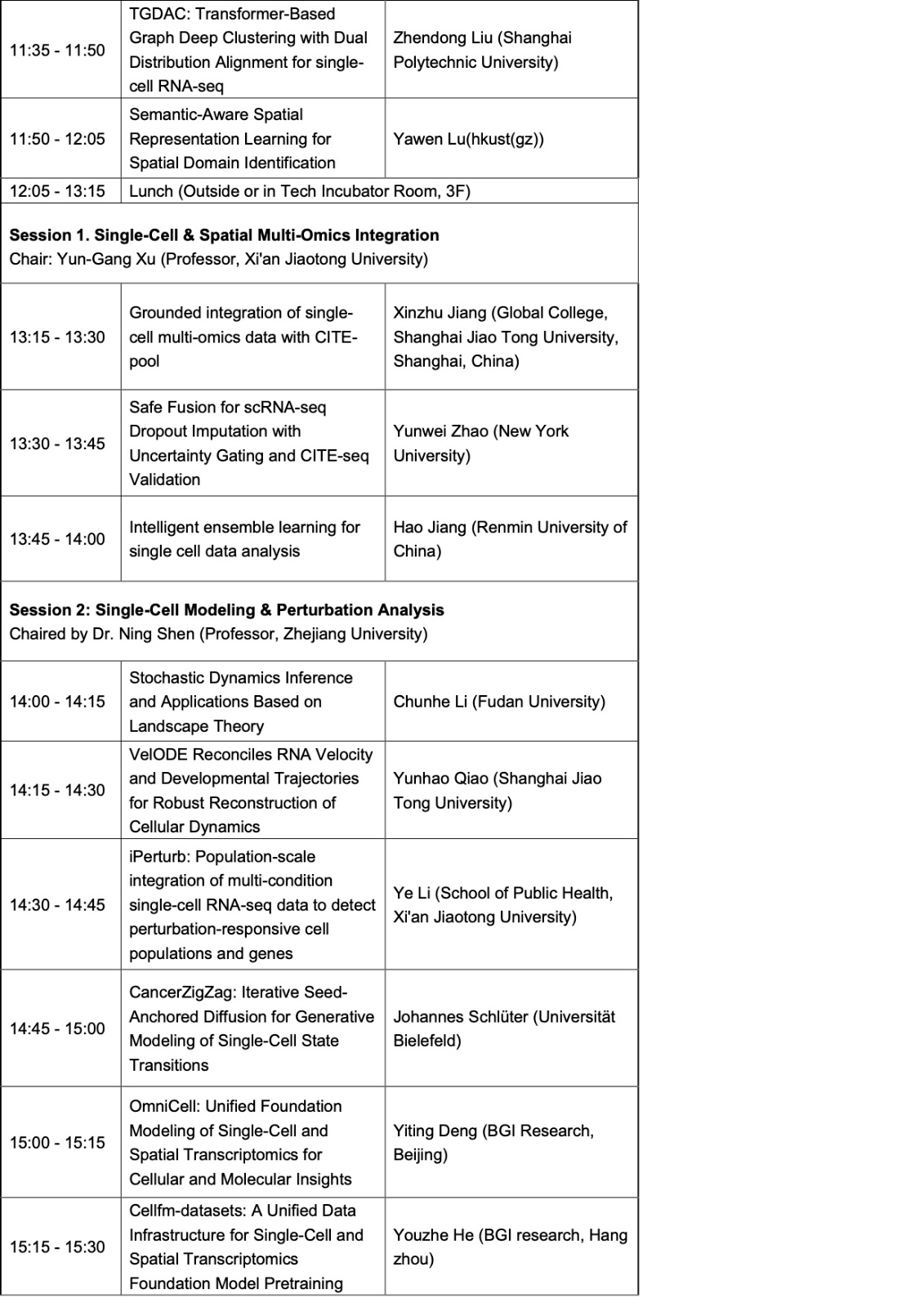
TGDAC: Transformer-Based Graph Deep Clustering with Dual Distribution Alignment for single-cell RNA-seq

Zhendong Liu (Shanghai Polytechnic University)

11:50 - 12:05

Semantic-Aware Spatial Representation Learning for Spatial Domain Identification

Yawen Lu(hkust(gz))

12:05 - 13:15

Lunch (Outside or in Tech Incubator Room, 3F)

13:15 - 13:30

SPINNMF: Stable Spatial Transcriptional Program Discovery Linking Spatial Programs to Genetic Risk via Consensus Graph-Regularized Poisson NMF

Caicai Zhang (The University of Hong Kong)

13:30 - 13:45

Domain-Adversarial Multi-Scale Autoencoder for Cross-Sample and Cross-Platform Spatial Transcriptomics Integration

Dong Zhang (SJTU)

13:45 - 14:00

Safe Fusion for scRNA-seq Dropout Imputation with Uncertainty Gating and CITE-seq Validation

Lakshminarayanan Subramanian (New York University)

14:00 - 14:15

Intelligent ensemble learning for single cell data analysis

Hao Jiang (Renmin University of China)

14:15 - 15:00

Break


Session 2: Single-Cell Modeling & Perturbation Analysis

15:00 - 15:15

Stochastic Dynamics Inference and Applications Based on Landscape Theory

Chunhe Li (Fudan University)

15:15 - 15:30

VelODE Reconciles RNA Velocity and Developmental Trajectories for Robust Reconstruction of Cellular Dynamics

Yunhao Qiao (Shanghai Jiao Tong University)

15:30 - 15:45

iPerturb: Population-scale integration of multi-condition single-cell RNA-seq data to detect perturbation-responsive cell populations and genes

Ye Li (School of Public Health, Xi'an Jiaotong University)

15:45 - 16:00

CancerZigZag: Iterative Seed-Anchored Diffusion for Generative Modeling of Single-Cell State Transitions

Johannes Schlüter (Universität Bielefeld)

16:00 - 16:15

OmniCell: Unified Foundation Modeling of Single-Cell and Spatial Transcriptomics for Cellular and Molecular Insights

Jiangshuan Pang (BGI Research, Beijing)

16:15 - 16:30

Cellfm-datasets: A Unified Data Infrastructure for Single-Cell and Spatial Transcriptomics Foundation Model Pretraining

Liluojing Zhang (BGI research, Hang zhou)

16:00 - 16:15

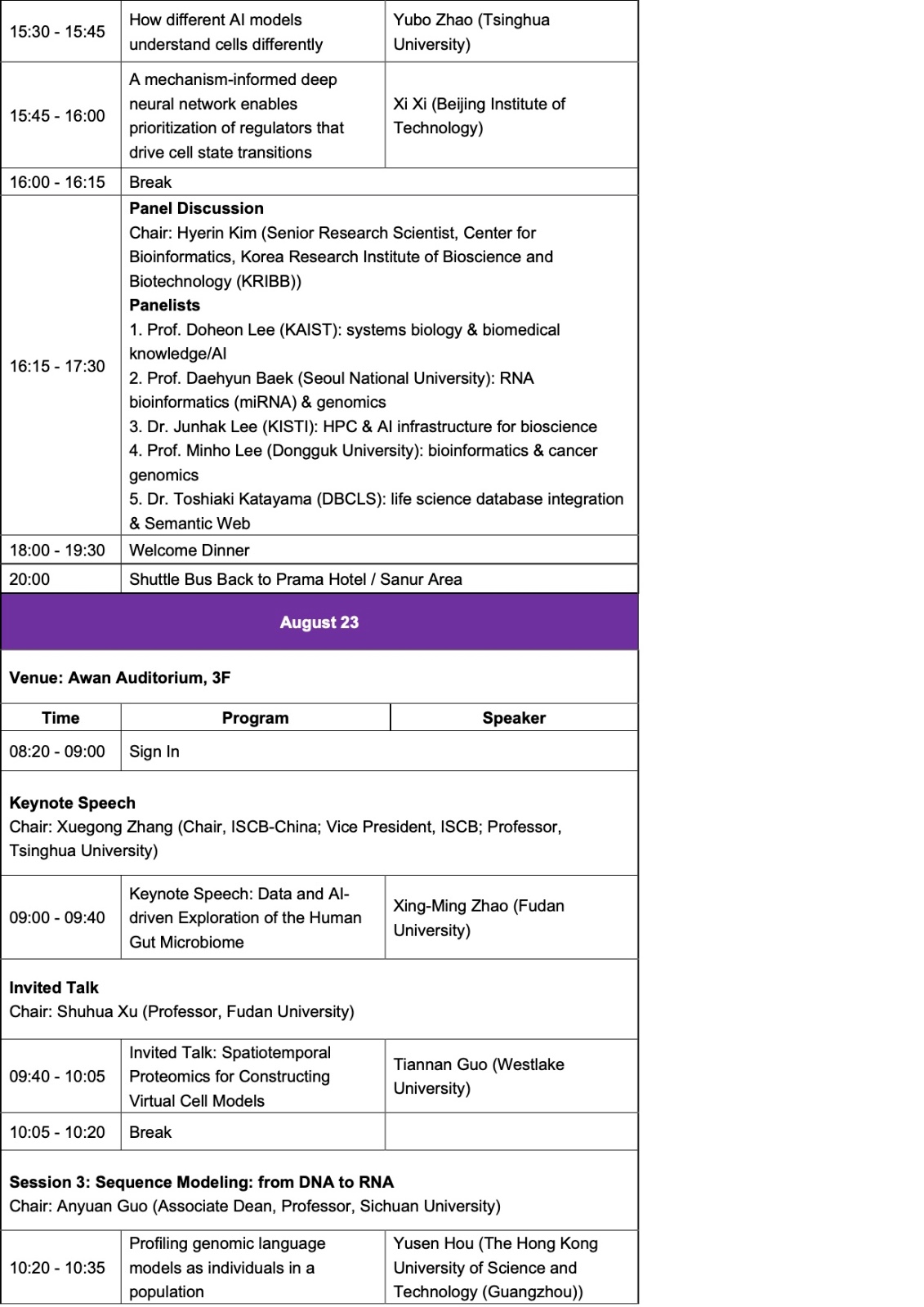
How different AI models understand cells differently

Yubo Zhao (Tsinghua University)

16:15 - 16:30

A mechanism-informed deep neural network enables prioritization of regulators that drive cell state transitions

Xi Xi (Beijing Institute of Technology)

16:30 - 16:45

Break


16:45 - 17:30

Panel Discussion


Welcome Dinner

18:00 - 19:30

Welcome Dinner

20:00

Shuttle Bus Back to Prama Hotel / Sanur Area

August 23

Venue: Awan Auditorium, 3F

Time

Arrangement

Speaker

08:20 - 09:00

Registration


09:00 - 09:05

Opening


09:05 - 09:45

Keynote Speech: Seq2image: A Holistic Image-Based Paradigm for Genomic Sequence Analysis

Kai Ye (Xi’an Jiaotong University)

09:45 - 10:10

Invited Talk: Data and AI-driven Exploration of the Human Gut Microbiome

Xing-Ming Zhao (Fudan University)

10:10 - 10:35

Invited Talk: Spatiotemporal Proteomics for Constructing Virtual Cell Models

Tian-Nan Guo (Westlake University)

10:35 - 10:50

Break


Session 3: Sequence Modeling: from DNA to RNA

10:50 - 11:05

Profiling genomic language models as individuals in a population

Yusen Hou (The Hong Kong University of Science and Technology (Guangzhou))

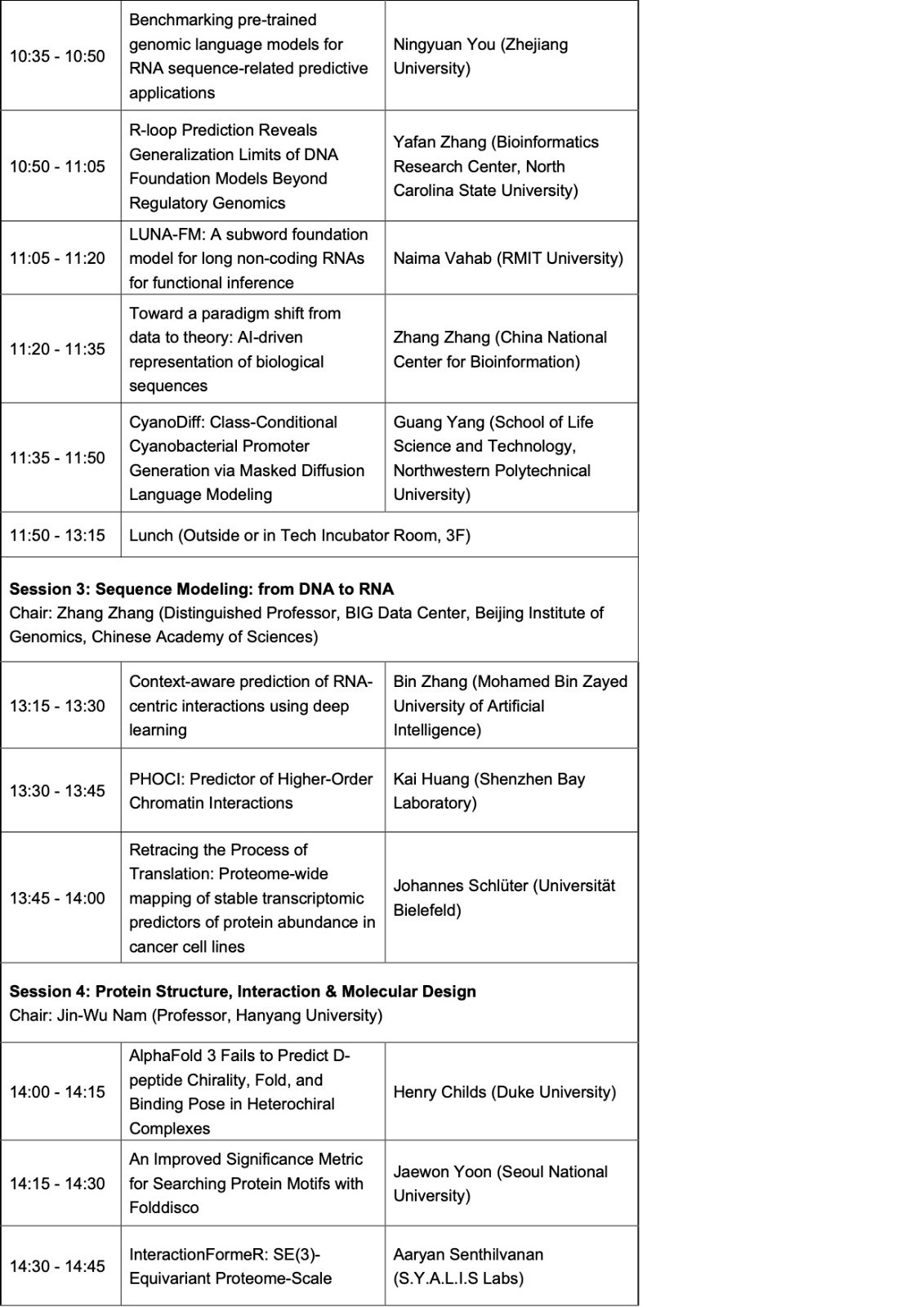
11:05 - 11:20

Benchmarking pre-trained genomic language models for RNA sequence-related predictive applications

Ningyuan You (Zhejiang University)

11:20 - 11:35

R-loop Prediction Reveals Generalization Limits of DNA Foundation Models Beyond Regulatory Genomics

Yafan Zhang (Bioinformatics Research Center, North Carolina State University)

11:35 - 11:50

LUNA-FM: A subword foundation model for long non-coding RNAs for functional inference

Naima Vahab (RMIT University)

11:50 - 12:05

Toward a paradigm shift from data to theory: AI-driven representation of biological sequences

Zhang Zhang (China National Center for Bioinformation)

12:05 - 13:15

Lunch (Outside or in Tech Incubator Room, 3F)

13:15 - 13:30

CyanoDiff: Class-Conditional Cyanobacterial Promoter Generation via Masked Diffusion Language Modeling

Guang Yang (School of Life Science and Technology, Northwestern Polytechnical University)

13:30 - 13:45

Context-aware prediction of RNA-centric interactions using deep learning

Bin Zhang (Mohamed Bin Zayed University of Artificial Intelligence)

13:45 - 14:00

PHOCI: Predictor of Higher-Order Chromatin Interactions

Kai Huang (Shenzhen Bay Laboratory)

14:15 - 14:30

Retracing the Process of Translation: Proteome-wide mapping of stable transcriptomic predictors of protein abundance in cancer cell lines

Johannes Schlüter (Universität Bielefeld)

14:30-14:45

Break


Session 4: Protein Structure, Interaction & Molecular Design

14:45 - 15:00

AlphaFold 3 Fails to Predict D-peptide Chirality, Fold, and Binding Pose in Heterochiral Complexes

Henry Childs (Duke University)

15:00 - 15:15

An Improved Significance Metric for Searching Protein Motifs with Folddisco

Jaewon Yoon (Seoul National University)

15:15 - 15:30

MolX: A Geometric Foundation Model for Protein-Ligand Modelling

Fuyi Li (Adelaide University)

15:30 - 15:45

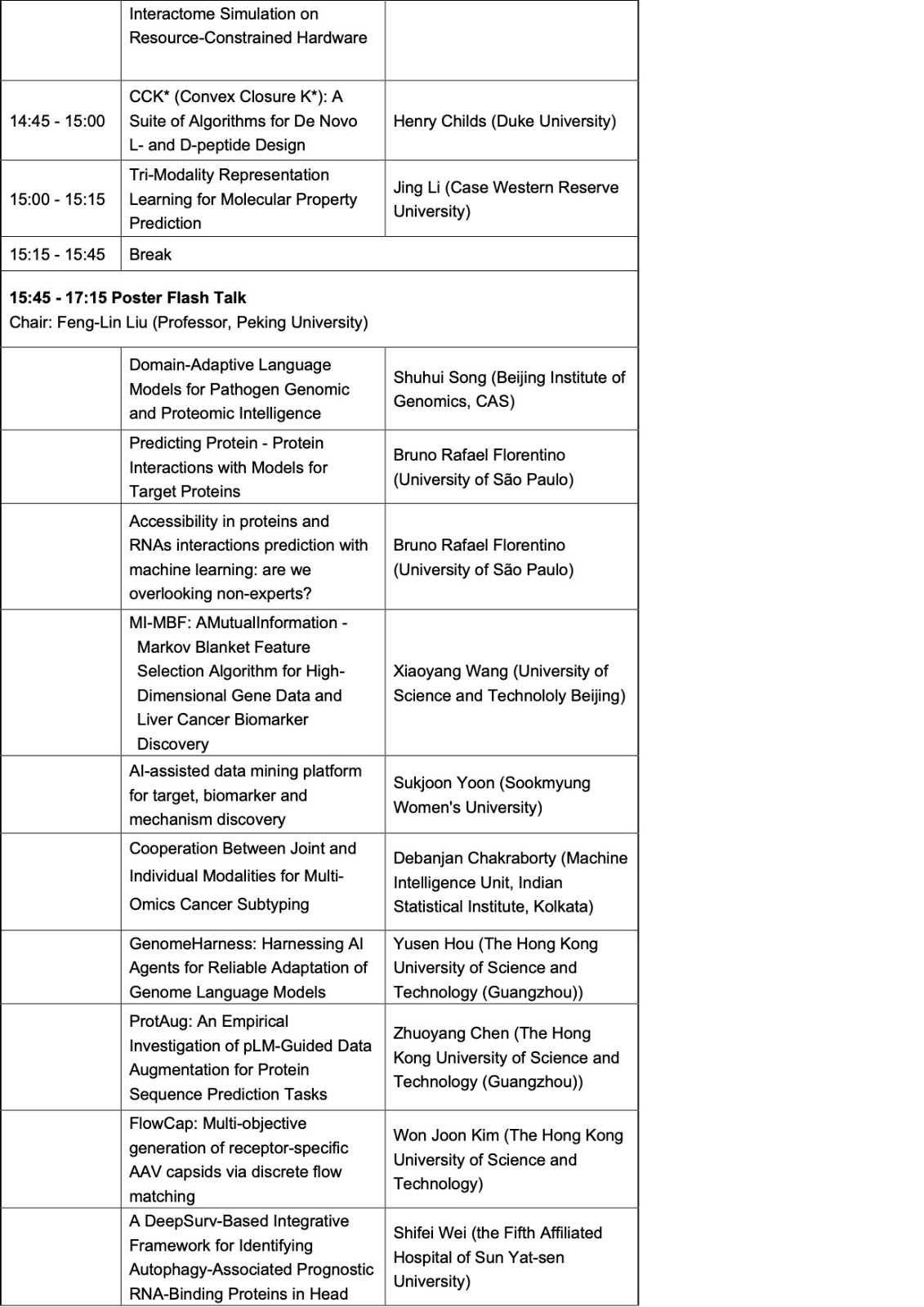
InteractionFormeR: SE(3)-Equivariant Proteome-Scale Interactome Simulation on Resource-Constrained Hardware

Aaryan Senthilvanan (S.Y.A.L.I.S Labs)

15:45 - 16:00

CCK* (Convex Closure K*): A Suite of Algorithms for De Novo L- and D-peptide Design

Henry Childs (Duke University)

16:00 - 16:15

Tri-Modality Representation Learning for Molecular Property Prediction

Jing Li (Case Western Reserve University)

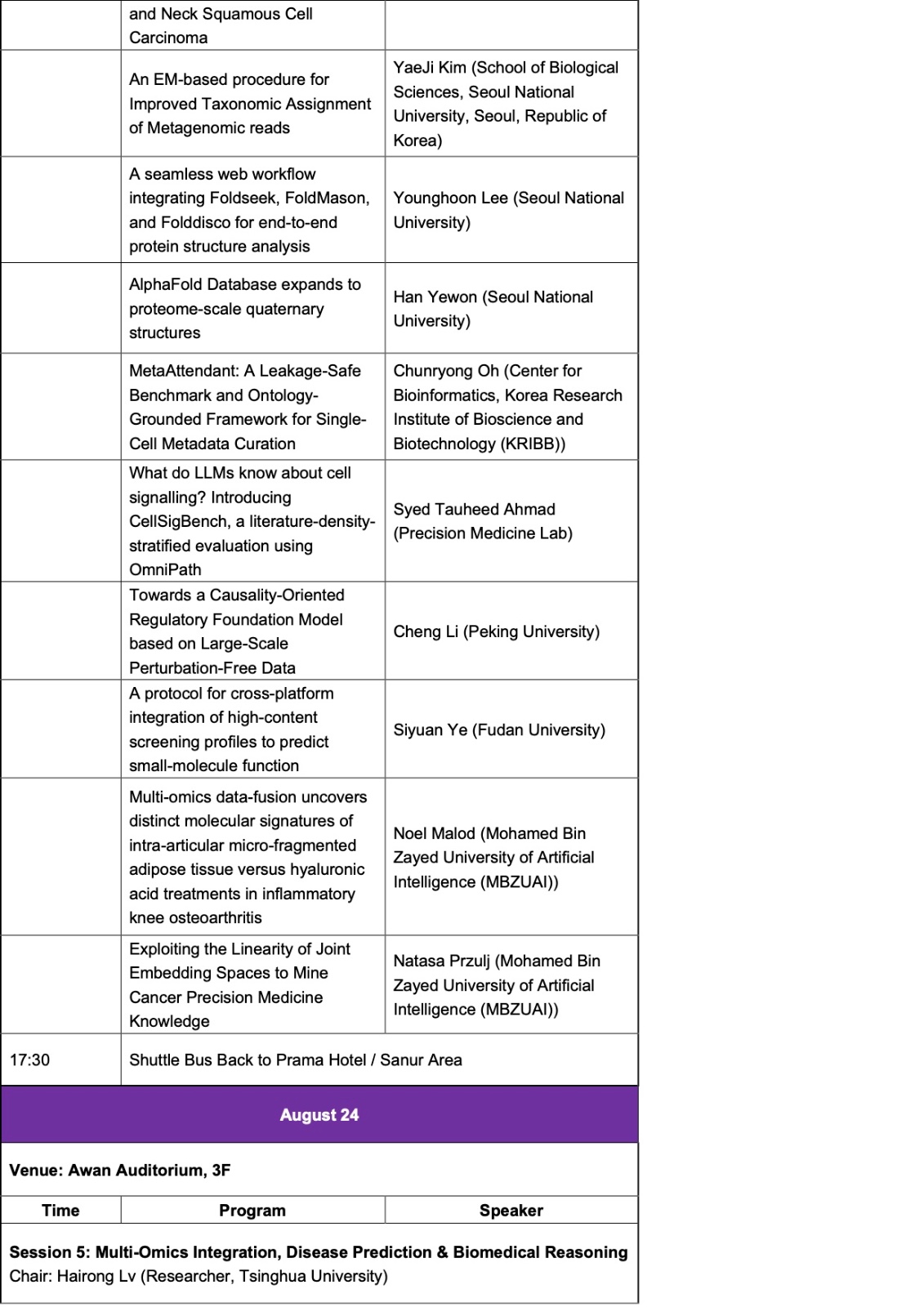
16:15 - 17:30    Poster Flash Talk  

17:30

Shuttle Bus Back to Prama Hotel / Sanur Area

August 24

Venue:  Awan Auditorium, 3F

Time

Arrangement

Speaker

09:00 - 09:05

Opening


Session 5: MultiOmics Integration, Disease Prediction & Biomedical Reasoning

09:05 - 09:20

Strategies for Constructing Central Dogma Foundation Model (CDFM) for Medical Needs

Sun Kim (Seoul National University / AIGENDRUG Co. Ltd)

09:20 - 09:35

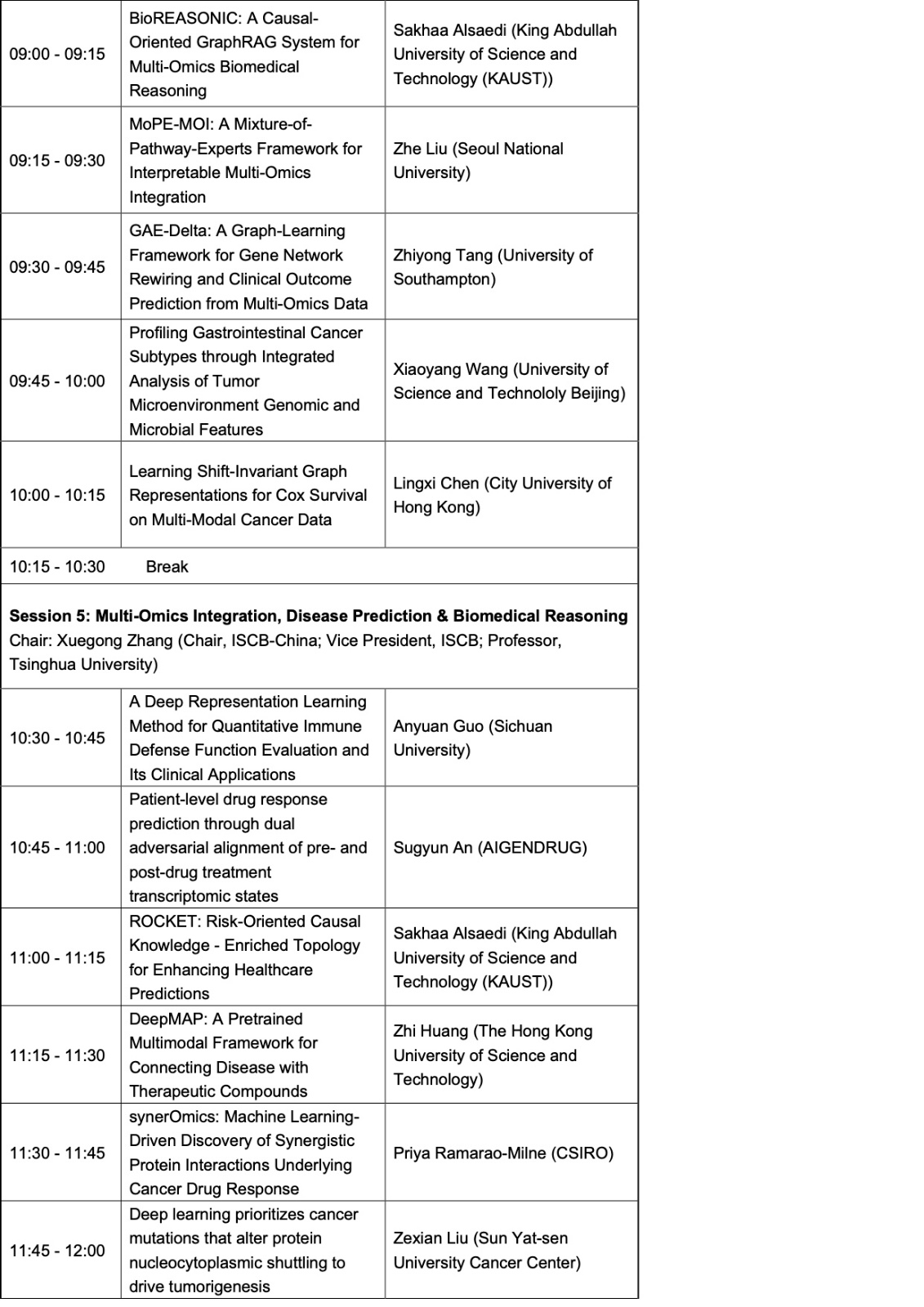
BioREASONIC: A Causal-Oriented GraphRAG System for Multi-Omics Biomedical Reasoning

Sakhaa Alsaedi (King Abdullah University of Science and Technology (KAUST))

09:35 - 09:50

MoPE-MOI: A Mixture-of-Pathway-Experts Framework for Interpretable Multi-Omics Integration

Zhe Liu (Seoul National University)

09:50 - 10:05

GAE-Delta: A Graph-Learning Framework for Gene Network Rewiring and Clinical Outcome Prediction from Multi-Omics Data

Zhiyong Tang (University of Southampton)

10:05 - 10:20

Profiling Gastrointestinal Cancer Subtypes through Integrated Analysis of Tumor Microenvironment Genomic and Microbial Features

Xiaoyang Wang (University of Science and Technololy Beijing)

10:20 - 10:35

Learning Shift-Invariant Graph Representations for Cox Survival on Multi-Modal Cancer Data

Lingxi Chen (City University of Hong Kong)

10:35 - 10:50     Break

10:50 - 11:05

A Deep Representation Learning Method for Quantitative Immune Defense Function Evaluation and Its Clinical Applications

An-Yuan Guo (Sichuan University)

11:05 - 11:20

Patient-level drug response prediction through dual adversarial alignment of pre- and post-drug treatment transcriptomic states

Sugyun An (AIGENDRUG)

11:20 - 11:35

ROCKET: Risk-Oriented Causal Knowledge - Enriched Topology for Enhancing Healthcare Predictions

Sakhaa Alsaedi (King Abdullah University of Science and Technology (KAUST))

11:35 - 11:50

DeepMAP: A Pretrained Multimodal Framework for Connecting Disease with Therapeutic Compounds

Zhi Huang (The Hong Kong University of Science and Technology)

11:50 - 12:05

synerOmics: Machine Learning-Driven Discovery of Synergistic Protein Interactions Underlying Cancer Drug Response

Priya Ramarao-Milne (CSIRO)

12:05 - 13:15

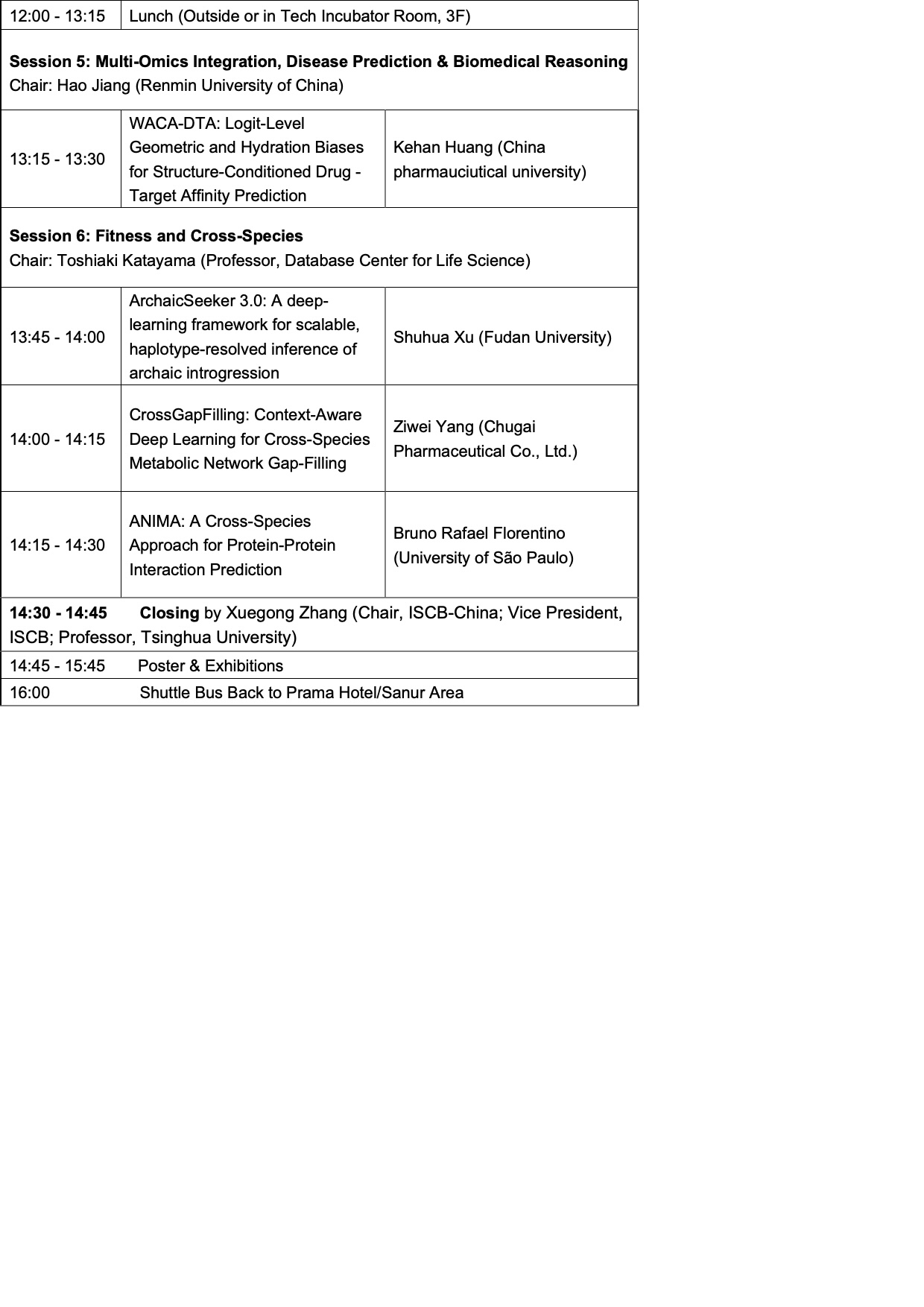
Lunch (Outside or in Tech Incubator Room, 3F)

13:15 - 13:30

CancerGen-RAG: A Framework for Scalable Lung Cancer Variant Prioritization and Interpretation


13:30 - 13:45

Deep learning prioritizes cancer mutations that alter protein nucleocytoplasmic shuttling to drive tumorigenesis

Zexian Liu (Sun Yat-sen University Cancer Center)

13:45 - 14:00

SPRINT: A SNP-PRS Residual Integration Model for Complex Disease Genetic Risk Prediction


14:00 - 14:15

WACA-DTA: Logit-Level Geometric and Hydration Biases for Structure-Conditioned Drug - Target Affinity Prediction

Kehan Huang (China pharmauciutical university)

15:00 - 15:15    Break

Session 6: Fitness and Cross-Species

15:15 - 15:30

ArchaicSeeker 3.0: A deep-learning framework for scalable, haplotype-resolved inference of archaic introgression

Shuhua Xu (Fudan University)

15:30 - 15:45

CrossGapFilling: Context-Aware Deep Learning for Cross-Species Metabolic Network Gap-Filling

Ziwei Yang (Kyoto University)

15:45 - 16:00

ANIMA: A Cross-Species Approach for Protein-Protein Interaction Prediction

Bruno Rafael Florentino (University of São Paulo)

16:00 - 16:15

NR-ProtFit: Noise-Robust Protein Fitness Prediction via Protein Language Model-Guided Label Refinement

Mingyi Sun (The Hong Kong University of Science and Technology)

16:15 - 16:20

Closing


16:15 - 17:15    Poster & Exhibitions

17:30           Shuttle Bus Back to Prama Hotel/Sanur Area


你知道你的Internet Explorer是过时了吗?

为了得到我们网站最好的体验效果,我们建议您升级到最新版本的Internet Explorer或选择另一个web浏览器.一个列表最流行的web浏览器在下面可以找到.